
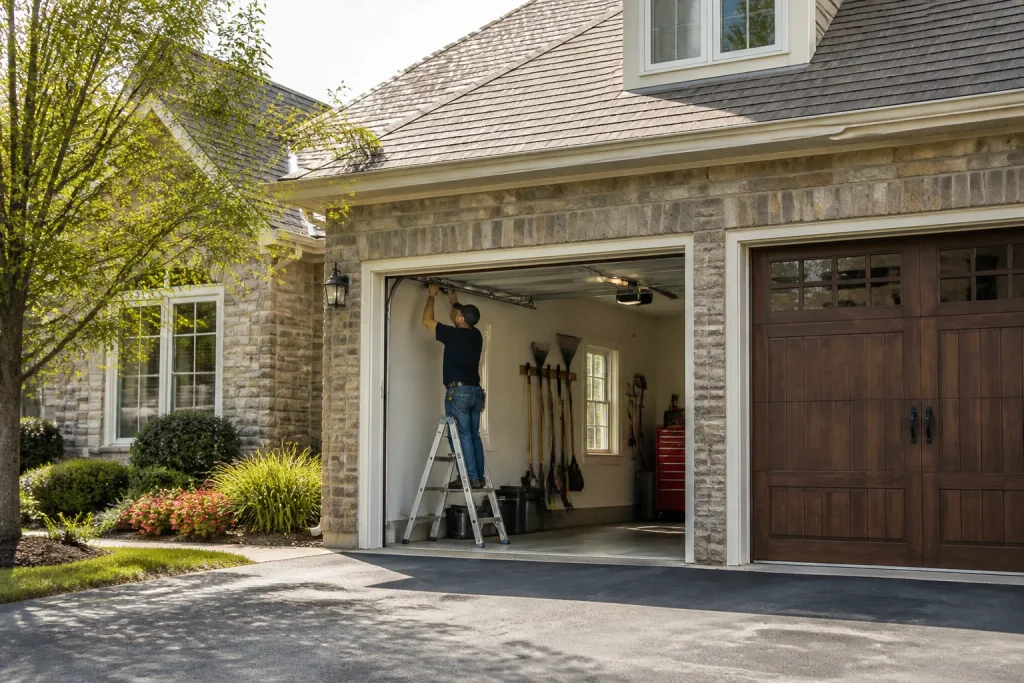
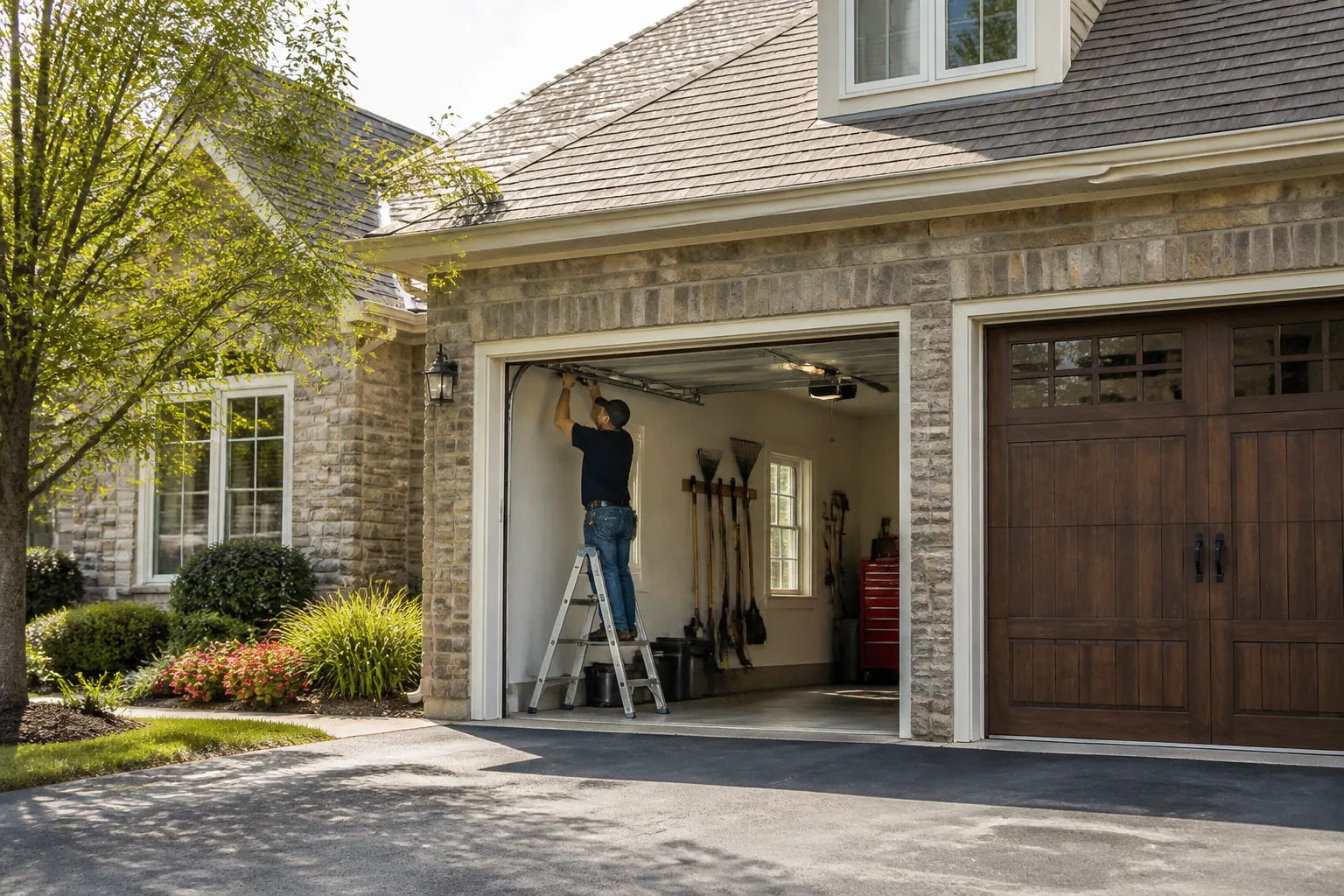
LiftMaster Garage Door Repair in Leesburg: A Homeowner’s Guide
Most LiftMaster problems announce themselves before the door ever stops moving. The opener blinks a code at you, the MyQ app goes quiet, or the wall button flashes and nothing happens. Homeowners in Leesburg often replace a battery or assume the motor is dead when the unit has been telling them exactly what’s wrong for days. This guide decodes those signals: what LiftMaster blink codes mean on the 8500, 8550, and Elite series, why MyQ drops get blamed on the opener, which parts wear fastest in our humidity, and which fixes are genuinely safe to handle yourself. If you’d rather skip the guesswork, call (844) 427-1950. We answer 24/7, and estimates are free.
Key Takeaways
- LiftMaster blink codes point to a specific circuit or sensor; count the flashes before you call anyone.
- A dead MyQ app is often a router band or DHCP conflict, not a failed opener.
- Photo-eye alignment and trolley carriage wear are the most common mechanical faults in Leesburg’s humid summers.
- Torsion springs and logic board swaps are not DIY jobs.
- Ask whether the tech is authorized to service LiftMaster before any parts come off the wall.
How Do You Read LiftMaster Blink Codes on 8500, 8550, and Elite Series Openers?
The diagnostic LED on the back of the motor, or the light on the wall control, flashes in repeatable patterns. Count the flashes in one burst, note the pause, then count again. That pattern is the opener telling you where the fault sits.
On the 8500 and 8550 series, keep a few patterns in mind:
- Up-arrow flashing about five times: a travel or limit problem. The opener can’t confirm the door reached a programmed point, usually because the door is binding, a spring has weakened, or the limit switch slipped.
- Down-arrow flashing: the safety reverse didn’t pass its self-test, often a photo-eye or force setting issue.
- Rapid alternating flashes between the up and down arrows: the unit is in lock or diagnostic mode, or the wall control has a stuck input.
- No light or a faint glow on the logic board itself: power supply or board failure, not the motor.
Elite series units run similar logic with a more detailed display on some wall controls. The important thing is that the code names the circuit, not the motor. A LiftMaster that flashes “sensor” is rarely a bad motor. If the pattern doesn’t repeat cleanly, note whether it changes when the door is raised by hand. That single detail separates a binding door from an electronics fault before any tools touch the unit.
Why Does Your MyQ App Stop Connecting (and Why It’s Rarely the Opener)?
A MyQ app that won’t connect is usually a network problem, not an opener failure. The opener is doing exactly what its firmware was told to do. The connection broke somewhere between the unit and your router.
The usual suspects, in the order we’d check them:
- Router band: MyQ uses a 2.4 GHz connection. If your router recently switched to a combined 2.4/5 GHz network or renamed a band, the opener loses its route. Splitting the bands back out often restores the link.
- DHCP conflicts: a router reboot can hand the opener a new address, and the app can’t find it. Assigning a fixed address fixes this permanently.
- Firmware rollback: an automatic update, sometimes triggered during a power flicker, can leave the Wi-Fi gateway on an older firmware version. A manual update through the app usually resolves it.
- Distance and interference: an opener at the far end of a garage with a metal door and a stone wall between it and the router will drop. A Wi-Fi extender placed closer solves more cases than people expect.
Before you call anyone, restart the router, check the app version, and confirm the opener’s Wi-Fi light is on. If the app reconnects after a restart and drops again the next day, that’s a network conflict, not a failed opener. A garage door opener repair technician can check the gateway and the logic board together, but we’ve seen plenty of MyQ “failures” resolve at the router.
Which LiftMaster Components Wear Fastest in Leesburg’s Humidity Cycles?
Our summers swing between muggy afternoons and cool nights, and that cycle is hard on a few specific parts. The problems show up in a predictable order.
- Trolley carriage: the plastic and metal components in the carriage collect dust and grease, then swell slightly with humidity. Friction builds, the door runs rougher, and eventually the carriage binds on the rail. A noisy LiftMaster that runs fine in cooler weather and drags on a sticky afternoon is usually a carriage issue.
- Logic board capacitors: capacitors age faster in warm, humid conditions. A board that starts losing its program, forgets travel limits, or needs a reset more often than it used to is a capacitor problem, and it usually precedes a full board failure.
- Photo-eye alignment: the safety eyes and their brackets absorb a surprising amount of seasonal shift from temperature cycles and ground movement. A sun-facing or leaf-clogged eye trips a false reverse, and the opener shuts the door halfway and stops. Realigning and cleaning the eyes resolves it most of the time.
LiftMaster, Chamberlain, Genie, and Clopay hardware all show wear in these same places, but each opener has its own tolerances for when a worn carriage or a weak capacitor becomes a repair. Knowing which unit you’re looking at saves a phone call.
Which LiftMaster Repairs Are Safe to Handle Yourself?
Some LiftMaster fixes belong to the homeowner. A few do not, and the dangerous ones can cause serious injury if rushed.
Safe or low-risk:
- Replacing the remote battery and re-pairing the remote.
- Cleaning and realigning the photo-eyes with the brackets still in place.
- Reconnecting the opener to Wi-Fi and updating the app.
- Releasing the door with the manual emergency cord to see whether it moves freely by hand.
Not safe for a homeowner:
- Torsion spring repair or replacement. The springs are under significant tension, and one wrong adjustment can release that tension suddenly. Never remove the spring, the winding bars, or the cable with the door in any position other than fully down and unloaded, and leave the springs to a trained technician. Our garage door spring repair is handled as a core specialty for exactly this reason.
- Logic board replacement or capacitor work. The board carries live voltage, and the wrong capacitor or a shorted board can damage the opener permanently. A technician should confirm the board is the fault before swapping it.
- Any repair involving the mounting hardware or the door’s balance. If the door lifts unevenly, the opener isn’t the problem.
How Do You Verify a LiftMaster-Authorized Technician in Leesburg?
A LiftMaster-authorized technician carries authorization from the brand, not just a tool bag. That authorization generally covers factory-certified parts, access to genuine LiftMaster components, and the training to diagnose the unit correctly. Ask three questions before any tech touches your door.
- Ask whether the tech is authorized to service LiftMaster specifically. General handyman experience with openers is not the same as brand authorization.
- Ask what the authorization covers: parts for the 8500, 8550, and Elite series, or just the older motor line?
- Ask whether replacement parts come with a warranty tied to the installation or only the part itself.
The answers tell you whether you’re getting a technician who knows your unit or someone learning on it. Our technicians have up to 8 years of experience across LiftMaster, Chamberlain, Genie, Clopay, Amarr, Wayne Dalton, Craftsman, and Raynor, and they arrive familiar with the specific parts and procedures your model uses. If you’re in Leesburg and want to confirm before you book, call (844) 427-1950. We answer 24/7, with fast dispatch from 7am to 7pm, Sunday through Friday.
When to Call a Pro
If your LiftMaster blinks a code that points to the logic board, the springs are under load, or the door runs unevenly by hand, stop there. Those are the jobs where the right diagnosis saves money and the wrong move causes injury or a bigger repair. For routine door problems, our garage door repair covers the whole unit, and for a full system review from the door up, visit Leesburg Garage Door Repair.
Do You Need a Same-Day Visit for a Stuck LiftMaster in Leesburg?
A door stuck open is a security problem, and a door stuck shut means nobody can leave. If you’ve tried the manual release and a router restart and the opener still won’t respond, that’s a same-day repair call, not an installation.
On a typical visit, the technician checks the blink code you’ve already noted, confirms the photo-eyes and carriage, tests the logic board, and then gives you a quoted price before any work starts. The price you agree to is the price on the final invoice. If a spring or a board turns out to be the fault, the technician explains the options and you decide. No work happens before you say yes.
Emergency service is a core part of what we do because it has to be. If the door fails late at night or early in the morning, a call books into the next opening: We answer 24/7. Fast dispatch from 7am to 7pm, Sunday through Friday. We’re closed on Saturday, so a Saturday failure gets booked for Sunday. That’s the trade we work in, and the door needs to move again.
The Bottom Line
LiftMaster openers are good at telling you what’s wrong, if you know how to read the flashes and where to look. Start with the blink code, then the router for anything MyQ-related, then the photo-eyes and trolley carriage for mechanical wear. Leave the springs and the logic board to a trained technician. If you’re in Leesburg and need help, Leesburg Garage Door Repair offers free estimates. Call (844) 427-1950 to get a LiftMaster, Chamberlain, or Genie unit looked at properly.
Frequently Asked Questions
Each blink pattern points to a specific fault, not the motor itself. A flashing up arrow usually means the opener can’t confirm the door reached its travel point, often a binding door or weak spring. A flashing down arrow points to the safety reverse or photo-eyes. Rapid alternating flashes mean the unit is in lock or diagnostic mode. Call (844) 427-1950 and we’ll match the pattern to your exact model, free estimate included.
The most common causes are a router band switch, a DHCP address conflict, or a firmware rollback, not a failed opener. Restart the router and confirm the opener’s Wi-Fi light is on. If the link drops again the next day, check the 2.4 GHz band and assign the opener a fixed address. If the app still won’t connect, call (844) 427-1950 for a free estimate on a diagnostic visit.
No. Torsion springs are under tension that can release suddenly, and removal without the right tools and training risks serious injury. Logic boards carry live voltage and the wrong capacitor can damage the opener. Both belong to a trained technician. For anything involving the springs or the board, call (844) 427-1950. We’ll give you a written price before any work starts.
Typical estimated prices run from about $95 to $200 for a photo-eye, remote, or sensor issue, $180 to $340 for a single torsion spring, and $250 to $500 or more for a logic board replacement, depending on the model. The written estimate sets the final price, and it’s free. Call (844) 427-1950 for an exact quote.
The local professional who arrives is licensed and insured as Virginia requires, and we vet them before any appointment. The written estimate you approve is the price you pay, with no surprise on the invoice. Call (844) 427-1950. We answer 24/7. Fast dispatch from 7am to 7pm, Sunday through Friday.
Written by the team at Leesburg Garage Door Repair.
Need Garage Door Help?
Call Leesburg Garage Door Repair - the local pro we connect you with is licensed and insured, here with fast help in Leesburg.
(844) 427-1950