
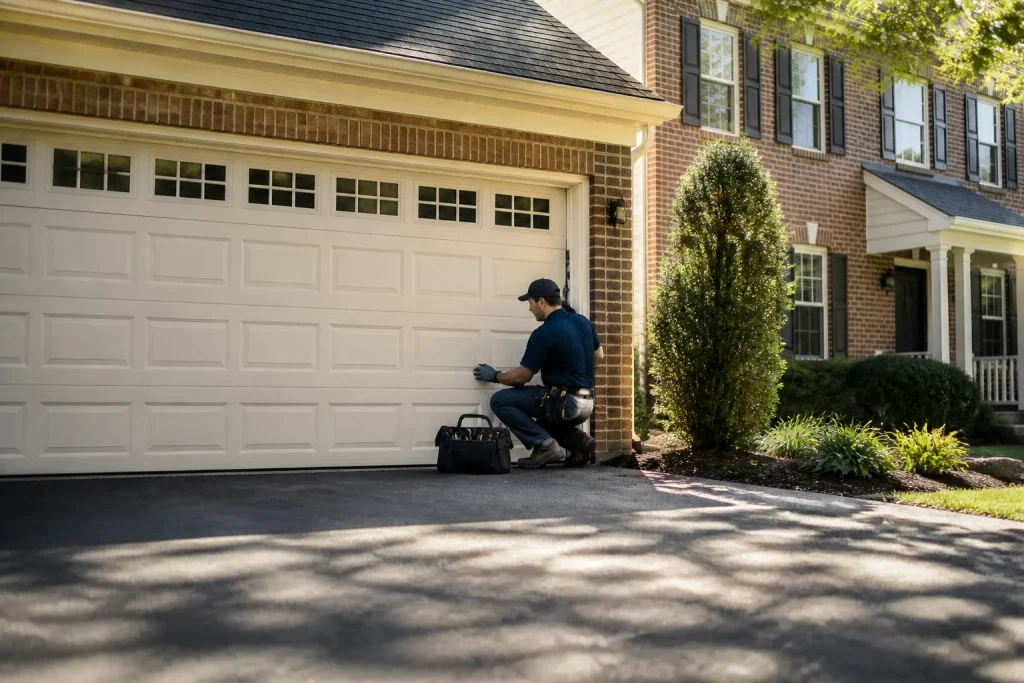
Garage Door Repair: Repair or Replace? How Leesburg Homeowners Decide
Plenty of Leesburg homeowners open the decision with the wrong question: “How old is my door?” Age tells you almost nothing. A 15-year-old door with one cracked panel and a healthy spring system is often a better repair candidate than a 7-year-old door whose bottom section has rotted through. What actually decides it is the relationship between what’s failing, what the rest of the door is worth, and what your community will let you put back on the house. Here’s the framework we use.
If you’d rather not work through it alone, call (844) 427-1950 for a free estimate. We answer 24/7.
Why the “10-Year Rule” Misleads Leesburg Homeowners
Ignore the calendar and score the components instead. A garage door is a frame, a set of panels, and a mechanical system, and those three things wear at completely different rates. The mechanical parts (springs, cables, rollers, opener) are consumables. The panels and framing are structural. When the structural side is sound, mechanical failures are repair work no matter how old the door is.
Here’s how we sort a door on site. Assign each problem to a column:
- Replace-weight (structural): rot in the bottom section, multiple warped or delaminated panels, a bent header bracket, sagging sections, a door that’s been backed into hard enough to twist the tracks.
- Repair-weight (mechanical): broken torsion or extension springs, frayed cables, worn rollers and hinges, a failed opener motor or logic board, misaligned photo eyes, a door that reverses for no clear reason.
Count the structural failures. One cracked panel on an otherwise straight door is a panel swap. Two or more structural problems, or rot that’s spread past the bottom section, and you’re usually past the point where patching makes financial sense. Two mechanical failures on a structurally sound door? That’s a repair, nearly every time.
The Component-by-Component Test: What’s Actually Failing?
Take a flashlight to the inside of the door and look at three things before you call anyone. First, the bottom section: push on it near the corners. Soft, spongy wood or bubbling paint means water has been sitting there. Second, sight down the door from the side while it’s closed. Panels should line up; a visible bow or a gap at one corner is a structural flag. Third, look at the springs above the door. A clean break in a torsion spring or a stretched, gap-toothed extension spring is a mechanical problem, and a fixable one.
What separates a bridge repair from a long-term fix is what you’re bolting the new part onto. Replacing a spring on a door with two warped panels buys you about a year, not seven. The spring will outlive the panels, and then you’ll be paying for the door anyway. We’d rather tell you that up front than sell you a spring and see you again next spring. On a door that’s otherwise straight and sealed, a fresh set of springs and cables is genuinely long-term work.
Speaking of springs: this is the one part of the door homeowners should never touch. Torsion springs store an enormous amount of energy, and a spring under tension can cause serious injury in a fraction of a second. Spring work belongs with a trained technician, full stop. We handle garage door spring repair as a core specialty rather than something we farm out, because it’s the most common failure we see and the one that most needs doing right.
How Leesburg’s HOA Communities Change the Math
In Leesburg, the repair-versus-replace question has a wrinkle most decision guides skip: your community’s exterior material rules. The HOA-governed neighborhoods around Lansdowne, River Creek, and Potomac Station often specify door styles, panel profiles, and exterior materials. That matters because a panel swap is only a real option if the replacement panel matches what your community approved in the first place.
Here’s how to check before you commit to either path:
- Pull your community’s architectural guidelines and find the section on garage doors.
- Confirm the specific panel profile and color your home was built with or approved for.
- Ask your HOA whether a like-for-like panel replacement needs approval, or only a full door change does.
- If the original manufacturer still makes that panel (Clopay and Amarr both keep long production runs on common profiles), a swap is usually the cheaper compliant route.
A common trap: a homeowner replaces two damaged panels with a close-enough profile, then finds out at resale that the door no longer matches the approved spec. Get the paperwork sorted first. If the panel is discontinued, replacement becomes the compliant option by default.
When Insulation Tips the Decision Toward Replacement
Most attached garages in Loudoun County were built with an uninsulated or lightly insulated door, and the garage shares at least one wall with the house. That’s where energy math enters the picture. The rough threshold we use: once a door reaches R-9 insulation, replacing an older uninsulated door starts to pay back in comfort and energy use on an attached garage. Below that, the energy argument is thin, and you should decide on structure and safety alone.
If your door is a basic steel model with no insulation and the panels are already showing rust or warping, a modern insulated door from a line like Wayne Dalton or Clopay solves two problems at once. If your door is already insulated and the only issue is a tired opener or a broken spring, replacement won’t move the needle on energy. Repair it.
How to Get an Unbiased Assessment
Be direct about the conflict of interest, because it’s real: a company that sells doors has a financial reason to recommend a door. The honest answer isn’t to avoid those companies. It’s to ask questions that force the technician to show their reasoning.
Ask these four:
- “Which specific components are failing, and which are still good?” A real diagnosis names parts. A vague “it’s just old” is a sales answer.
- “If this were your door, what would you do, and why?” Listen for a reason tied to structure, not age.
- “Can you repair it, and what would that cost versus replacement?” If repair isn’t offered as an option at all, ask why.
- “Will a repair void anything or create a mismatch with my existing panels?” Honest techs will flag the bridge-repair problem before you pay for it.
We work on the door you have, not just the brands we happen to sell, so a repair recommendation doesn’t cost us anything. Our technicians have up to 8 years of experience across LiftMaster, Chamberlain, Genie, Clopay, Amarr, Wayne Dalton, Craftsman, and Raynor systems, and we’ll tell you plainly when a repair is the smarter spend.
When to Call a Pro
Call a professional for anything involving springs, cables, or the opener’s electrical connections. Those are the parts where a mistake can injure you or burn out a control board. Also call if the door is stuck open (your house is exposed), stuck shut (nobody’s driving anywhere), or reversing unpredictably. For those time-sensitive failures, we run emergency response as a primary service, because a failed door is a security problem and a logistics problem at the same time.
Same-day repair is available for most mechanical failures. For a full door replacement, we measure, order, and schedule, so plan on a written quote and a scheduled install rather than a same-day swap. Call (844) 427-1950. We answer 24/7. Fast dispatch from 7am to 7pm, Sunday through Friday.
Related services in Leesburg: if you need garage door repair for a mechanical failure, we can usually get to it the same day. If the opener is the culprit, garage door opener repair covers both older motors and modern Wi-Fi and app-connected units. And when replacement is the right call, our Leesburg garage door repair team handles the full measure-and-install process. One call covers everything from a broken cable to a brand-new door.
The Bottom Line
Decide on components, not age. Here’s the short version:
- Repair when failures are mechanical (springs, cables, rollers, opener) and the panels and frame are straight and sealed.
- Replace when you have two or more structural failures, rot past the bottom section, or a bent header bracket.
- Check your HOA rules in Lansdowne, River Creek, or Potomac Station before choosing a panel swap. Compliance decides the option.
- Weigh insulation if your attached garage has an old uninsulated door; R-9 is roughly where energy savings start to count.
- Watch for bridge repairs. A new spring on two warped panels is a 12-month fix, not a long-term one.
The price is always quoted and agreed before any work starts, so you’ll know the written estimate before a technician touches the door. If you’re in Leesburg and need help deciding, Leesburg Garage Door Repair offers free estimates. Call (844) 427-1950.
Frequently Asked Questions
Repair it if the failures are mechanical and the panels and frame are structurally sound. Replace it if you have two or more structural problems, such as rot in the bottom section or multiple warped panels. Age alone isn’t a reason to replace. Call (844) 427-1950 for a free estimate and an honest assessment.
It depends on the component. Spring, cable, roller, and opener work are priced per job by a written estimate rather than a flat rate, because the parts and labor change with your door’s brand and model. Repair costs far less than a full replacement in most cases. Call (844) 427-1950 for an exact quote; estimates are free.
It can, especially in HOA communities where curb appeal and exterior compliance matter to buyers. A clean, correctly specified door reads well in listings and avoids the mismatch problem at inspection. Get any panel or door change approved by your HOA first, so the improvement actually counts. Call (844) 427-1950 to discuss options.
Ask which specific parts are failing and which are still good. A technician who names components and explains why a repair won’t last is giving you a real answer. One who only says “it’s old” is selling. We work on any brand and will tell you when a repair is the better spend. Call (844) 427-1950.
Written by the team at Leesburg Garage Door Repair.
Need Garage Door Help?
Call Leesburg Garage Door Repair - the local pro we connect you with is licensed and insured, here with fast help in Leesburg.
(844) 427-1950